







Imagine walking into a store, standing in front of a mirror, and instantly seeing dozens of makeup looks – from bold Kabuki drama to subtle everyday glow – projected right onto your face in real-time, without touching a single product or downloading an app. No filters, no distortions, just hyper-realistic results that move with your every expression. This isn’t science fiction; it’s Japan’s latest beauty tech breakthrough from cosmetics powerhouse KOSÉ and Tokyo Electron Device (TED), and it’s primed to explode globally – especially in India’s red-hot ₹2 lakh crore beauty market.
As Indian investors and business researchers dive deeper into world trends, this innovation screams opportunity. With President Trump’s pro-innovation policies boosting US-Japan tech ties since his 2025 inauguration, and India’s “Make in India” push for high-tech manufacturing, the timing couldn’t be better. Let’s unpack this game-changer, Japan’s relentless R&D behind it, and why it’s a must-watch for anyone serious about beauty, retail, and future-proof investments.
The Groundbreaking Tech: Projection Magic at 1000fps Speed
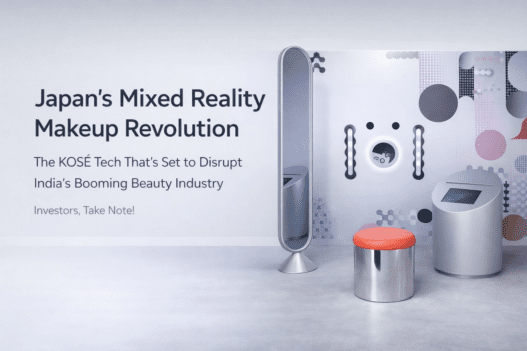
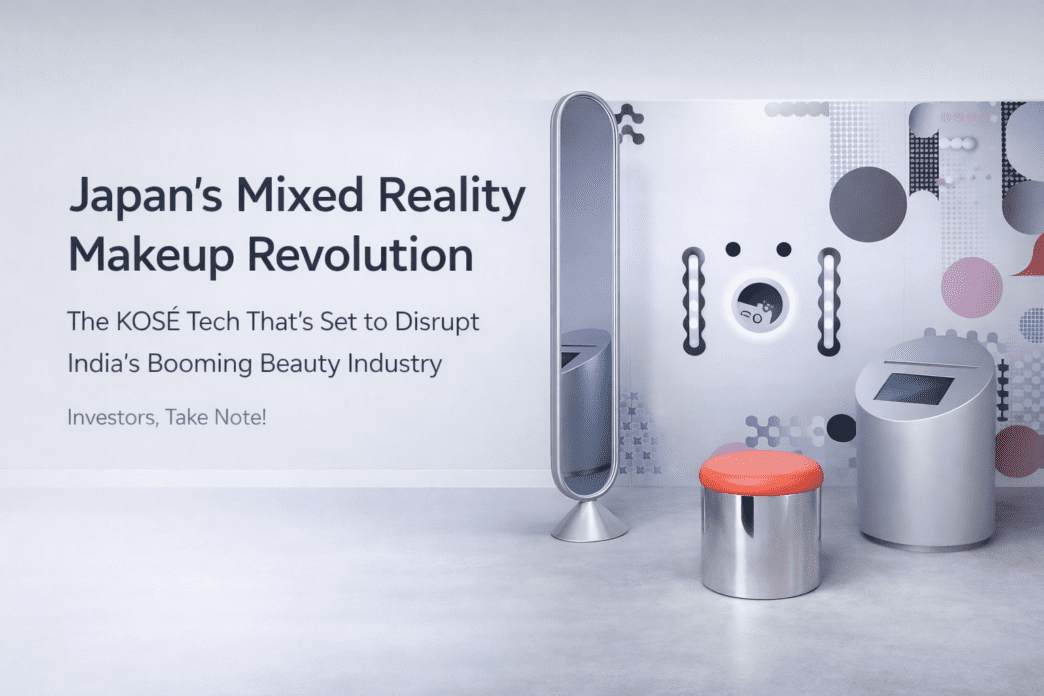
At its core, KOSÉ’s Mixed Reality (MR) Makeup system is a compact booth (just 2m x 3m) packing the world’s fastest 1000 frames-per-second projector, infrared (IR) sensors for pinpoint facial tracking, and AI-driven software that maps makeup onto your skin like a second layer. Blink, smile, turn your head – it adapts instantly, projecting eyeshadow gradients, blush contours, and lip shades with brand-specific colors and textures.
What sets it apart from clunky AR phone apps? True 3D realism without glare or eye strain (safer than AR glasses), customizable for any skin tone, and zero downloads needed. First launched in KOSÉ’s Ginza flagship store back in 2022, it slashed decision time for shoppers by letting them “try on” 20+ looks in seconds, boosting conversions and cutting returns. Pro versions now offer branded interfaces for pop-ups, malls, or e-commerce kiosks – think wedding seasons in India where brides test lehengas with perfect bridal makeup matches.
Early data? Over 1,400 CES 2025 testers raved about its accuracy, with retailers eyeing 30-50% sales lifts from confident, filter-free trials.
CES 2025: From Tokyo Lab to Global Spotlight
KOSÉ and TED stole the show at CES 2025 in Las Vegas with their “0 min try-on studio,” clinching the CES Innovation Award in the XR category. Visitors from Sephora to Indian chains like Nykaa queued up to test everything from neon festival looks to mature skincare simulations. TED’s stock jumped 15% post-event, signaling Wall Street’s bet on commercialization.
This builds on years of iteration: Ginza pilots proved it works in high-traffic stores, while CES feedback refined it for diverse global faces – crucial for India’s multi-ethnic market. Commercial rollout is underway, with Asia-Pacific first-movers like TOUCHBeauty integrating similar tech at Tokyo’s COSME Week 2026.
Japan’s Beauty Tech Research Ecosystem: A National Powerhouse
Japan isn’t just innovating; it’s rewriting the rules with a full-stack research machine. Government funding via METI (Ministry of Economy, Trade and Industry) pours billions into “Society 5.0,” blending AI, biotech, and cosmetics for aging populations and global exports. KOSÉ’s MR tech? Born from a collab with Institute of Science Tokyo’s Yoshihiro Watanabe Lab, pioneers in facial recognition and dynamic projection mapping.
Dive deeper: Saga University kicked off Asia’s first national School of Cosmetic Science in early 2026, enrolling 30 elite students yearly. Curriculum spans cosmetic chemistry, skin biomechanics, UV-protective formulations, and AI personalization – all with mandatory internships at Shiseido, KOSÉ, and Pola Orbis. Goal? Breed 1,000 experts by 2030 to lead “sensitive-skin” tech, where 40% of Japanese consumers demand hypoallergenic, atopic-safe products.
Other fronts:
-
Shiseido’s AI Skincare: JV with Accenture uses IoT mirrors and machine learning for real-time skin analysis, predicting aging via 3D scans – now expanding to Japan AR trials growing 25% YoY.
-
Tokyo University of Technology’s Shibata Lab: Develops revolutionary materials like mesoporous silica gels infused with natural pigments for breathable, long-wear makeup that suits humid climates (hello, Mumbai monsoons).
-
Revieve’s Japan Entry: This AI beauty platform, fresh off a 2025 expansion, integrates skin diagnostics with virtual try-ons, partnering local firms for $41B market capture by 2033 (3% CAGR).
Universities like Kyoto’s cosmetic engineering programs simulate skin reactions at molecular levels, while Osaka labs pioneer “smart cosmetics” with embedded sensors for pH-balanced release. Japan’s edge? Ruthless precision – R&D spend hits 4% of beauty GDP, dwarfing global averages.