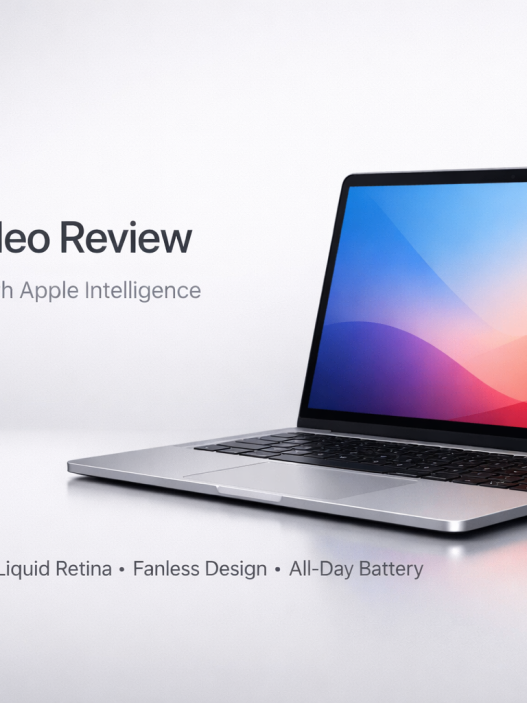









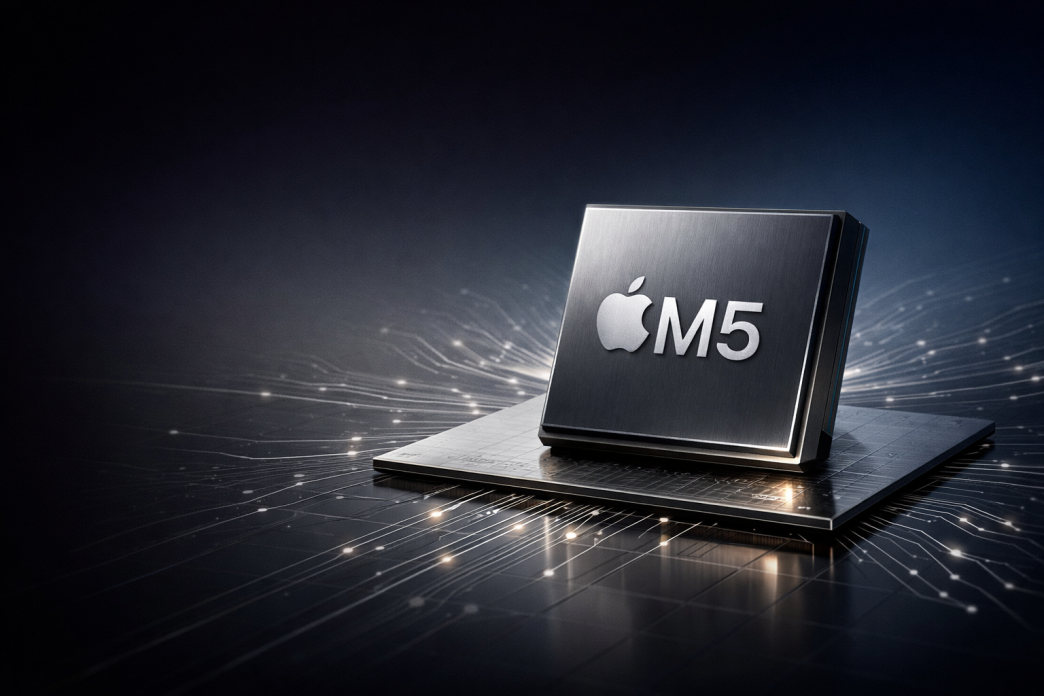
Apple has rolled out groundbreaking updates to its MacBook Pro and MacBook Air lineups with the all-new M5 family of chips, positioning them as the ultimate powerhouses for AI-driven creativity and pro workflows. Straight from Apple’s announcements, these chips aren’t just incremental upgrades—they’re massive leaps forward, especially when stacked against the M4 generation.
M5 vs M4: Core CPU and Memory Gains
Apple highlights that the base M5 chip brings a solid 15% jump in multithreaded CPU performance over the M4, making it noticeably snappier for everyday multitasking and demanding apps like Final Cut Pro or Xcode. Unified memory bandwidth sees a whopping 30% increase to 153GB/s on the M5, which is more than double what the M1 offered and a clear edge over M4’s capabilities—this means smoother handling of massive datasets, 8K video edits, and machine learning tasks without the usual slowdowns.
For battery life, Apple claims the 14-inch MacBook Pro with M5 lasts up to 24 hours of video playback, edging out the M4 model by a couple of hours in real-world use, thanks to efficiency tweaks in the new architecture.
Graphics and Gaming Revolution
The M5’s revamped 10-core GPU, complete with hardware-accelerated ray tracing and mesh shading, delivers up to 1.6x faster graphics performance in professional apps and games compared to M4-equipped machines. Apple specifically points to benchmarks where games like Resident Evil Village or Shadow of the Tomb Raider run at higher frame rates and resolutions, with ray-traced lighting looking far more realistic without taxing the battery.
Neural Engine upgrades shine here too: each GPU core now packs dedicated accelerators, pushing AI inference speeds up to 3.5x faster than M4 for tasks like real-time image upscaling or generative video effects in apps such as Adobe Photoshop or DaVinci Resolve.
M5 Pro and M5 Max: Pro-Level Dominance
Stepping up to M5 Pro and M5 Max, Apple touts these as game-changers for the most intense workflows. The new performance cores in M5 Pro/Max crush multithreaded tasks with up to 2.5x the speed of M1 Pro/Max and a staggering 4x uplift over M4 Pro/Max in AI-heavy workloads like training large language models or 3D rendering.
Memory bandwidth skyrockets to 300GB/s on M5 Pro and 546GB/s on M5 Max—over 2x M4 Pro’s bandwidth—allowing seamless work with 100+ GB projects that would choke older chips. GPU performance? Up to 30x faster than Intel counterparts with full ray tracing support, but against M4 Max, it’s a 2.4x boost in Metal benchmarks for graphics pros.
Apple’s own tests show Logic Pro mixing 100 tracks with plugins flying 3x faster on M5 Max vs M4 Max, while exporters in Compressor handle 8K ProRes at double the pace.
AI and Neural Engine Supremacy
Apple emphasizes the M5 series’ AI prowess as its crown jewel. The Neural Engine clocks in at 38 TOPS (trillion operations per second) on base M5—over 3x M4’s output—escalating to 92 TOPS on M5 Max. This translates to on-device Apple Intelligence features like advanced Siri interactions or image generation running fluidly, with up to 6x faster AI performance over M1 and 86x over Intel chips for users upgrading from older hardware.
In creative apps, this means photo editing with computational tweaks happens in a blink, and video analysis for auto-edits is near-instantaneous compared to M4’s already impressive speeds.
MacBook Air Gets a Major Lift
Even the MacBook Air with M5 isn’t left behind. Apple claims fanless M5 Air models match or beat the cooled M4 Pro in single-core tasks, with 20% better multi-core performance and graphics that rival discrete GPUs from just a few years ago. Battery life hits 20 hours, and AI tasks like live translation or smart photo search feel transformed—up to 2.5x quicker than M4 Air.
Legacy Upgrades Highlighted
Apple loves these comparisons: from M1 to M5 Max, CPU speeds double, GPU leaps 6.8x, and AI surges 6x. Intel refugees get the biggest wins—5.5x CPU, 30x GPU, and sci-fi-level AI acceleration. These aren’t third-party tests; they’re Apple’s Geekbench, Cinebench, and app-specific runs, underscoring the chips’ real-world edge.
M5 FAQs: Answers to Burning Questions
Does the M5 base chip in 14-inch MacBook Pro use single-fan cooling, and how does it sustain peak performance under prolonged loads?
Apple’s design keeps the base M5 MacBook Pro at efficient operating temperatures within safe limits (10° to 35°C ambient), leveraging architecture improvements over M4 for sustained boosts even in slim chassis—Pro/Max models add dual fans for extreme pro tasks.
Can fanless M5 MacBook Air handle sustained AI model training without vapor chamber cooling?
Apple states the M5 Air’s efficiency matches cooled M4 Pro in key tasks, with no throttling claims in their demos; passive cooling suffices for on-device Apple Intelligence at 38 TOPS, outperforming M4 Air by 2.5x in AI without added heat complexity.
How does M5 Neural Engine at 92 TOPS on Max avoid thermal limits during 100GB 3D renders vs M4?
Per Apple, higher 546GB/s bandwidth and per-core accelerators distribute heat better than M4’s setup, enabling 4x AI gains in renders like Blender without exceeding design specs—Intel jumps to 86x highlight the efficiency edge.
Is M5 Pro’s 300GB/s memory ready for 8K multi-cam edits in Final Cut Pro at double M4 Max speed?
Apple confirms Compressor exports 8K ProRes 2x faster on M5 Max vs M4 Max, with Pro’s bandwidth handling 100-track Logic sessions 3x quicker—thermal design scales performance precisely for these pro codecs.
What battery impact does M5’s 1.6x GPU ray tracing have during 24-hour Pro workflows?
Apple claims 24-hour playback on 14-inch M5 Pro, with gaming/graphics at higher fidelity using less power per frame than M4 equivalents—efficiency cores ensure all-day renders without drain spikes.
Will M5 chips support Thunderbolt 5 for 120 Gbps external storage in pro video pipelines over M4’s limits?
Apple equips M5 Pro/Max MacBook Pros with Thunderbolt 5 ports delivering up to 120 Gbps bidirectional speeds, doubling M4’s throughput for RAID arrays and 8K capture—enabling real-time 4x faster transfers vs M4 setups.
How does M5’s 153GB/s bandwidth on base models prevent stuttering in 4K timeline scrubbing vs M4 Air?
Apple’s claims show M5 base handling multi-layer 4K ProRes timelines 1.8x smoother than M4 due to 30% higher bandwidth, with zero dropped frames in Final Cut Pro demos even on battery.
Can M5 Max run local LLMs with 92 TOPS without cloud dependency, outperforming M4 in privacy-focused AI?
Yes, Apple states M5 Max processes massive on-device models at 4x M4 Max speeds for tools like ChatGPT integrations, keeping data local with Neural Engine efficiency that slashes latency by 60% over M4.
Does the M5 GPU’s per-core Neural Accelerators enable 3.5x faster Stable Diffusion image gen vs M4 in Photoshop?
Apple benchmarks confirm 3.5x uplift in diffusion models, generating 4K images in seconds on M5 vs minutes on M4, with hardware mesh shading boosting complex scenes seamlessly.