





7 Unique Motorcycle Gadgets Available in India (But Riders Would Trade Anything For)
Indian motorcycle riders are among the most safety-conscious and tech-savvy in the world, yet they’re limited by a market that lacks access to cutting-edge motorcycle technology. While basic accessories like helmets, jackets, and phone mounts are readily available, there’s a massive gap when it comes to advanced safety and convenience gadgets that are standard in developed markets.
Based on current market gaps and rider demand in India, here are some unique motorcycle gadgets officially available (or extremely hard to get) in India that would create massive demand if launched locally. These aren’t just nice-to-haves—they’re potentially life-saving technologies that Indian riders would pay premium prices for if they were officially available with local support and warranty.
1. Tethered & Electronic Airbag Vests (Premium Segment)
Current Situation in India:
While NeoKavach has entered the Indian market with affordable tethered airbags (~₹32k), high-end electronic airbag systems remain virtually unavailable. The few options that exist are either:
- Imported via grey channels at 2–3x international prices
- Lacking official service centers for cartridge replacement
- Limited to tethered systems that only work with specific bikes
What’s Missing:
- Alpinestars Tech-Air Race / Street (sensor-based, ~₹70k–₹1.2L internationally)
- Dainese Smart Jacket (~₹80k–₹1.5L internationally)
- Helite Double Turtle (tethered but premium, ~₹1.2L via import)
- Bering C-Protect Air Evo (electronic, ~₹60k–₹90k)
How They Work:
These vests deploy in 60–100 milliseconds using accelerometers, gyroscopes, and GPS sensors. Unlike tethered systems that only work when connected to the bike, electronic airbags work independently—protecting riders even when they’re off the bike (e.g., during a fall while pushing the motorcycle).
Key features include:
- Neck, chest, spine, and rib protection
- Multiple deployment modes (race, street, urban)
- Reusability (just replace the CO2 cartridge)
- Integration with smartphone apps for diagnostics
Why It Would Be a Dealbreaker:
India has the highest number of two-wheeler accident deaths globally. Current protective gear (jackets with armor) only protects against abrasion and minor impacts. An airbag vest reduces serious injury risk by 45–60% according to European studies. An officially launched, serviceable electronic airbag vest at ₹40k–₹60k would be a game-changer for:
- Long-distance tourers (Himalayan riders)
- Daily commuters in chaotic city traffic
- Professional delivery riders (Swiggy, Zomato, Amazon)
- Sports bike enthusiasts (KTM, Yamaha R-series, Ducati owners)
Market Potential: With 20+ million two-wheeler sales annually, even 1% adoption would mean 200,000 units/year.
2. 77GHz Motorcycle Blind Spot Radar Systems (Aftermarket)
Current Situation in India:
Blind spot detection is standard on cars above ₹10L, but motorcycles—even premium ones—lack this technology. The only exceptions are:
- Triumph Blind Spot Radar (only on Tiger 1200 Explorer variants, not as standalone accessory)
- Ultraviolette Hypersense Radar (only on X-47 top variant, not retrofit)
There’s no universal aftermarket kit available for Indian bikes.
What’s Missing:
- CHIGEE SR-1 Millimeter-Wave Radar (77GHz, blind spot + rear collision warning, ~$300–$500 internationally)
- Triumph Blind Spot Radar System (as standalone accessory)
- ZLY TECH 77GHz BSD Radar (universal fitment, ~$200–$350)
- Valeo ARAS Motorcycle Radar (in partnership with Hero, but not yet launched)
How They Work:
These radars use 77GHz millimeter-wave technology (same as modern cars) to detect vehicles up to 50m behind and 10m to the sides. Alerts are provided via:
- LED indicators on mirrors or dashboard
- Vibration alerts on handlebars
- Audio warnings through helmet speakers
Unlike cameras, radar works flawlessly in:
- Heavy rain and monsoons
- Fog and dust
- Night conditions
- Direct sunlight
Why It Would Be Irresistible:
Indian traffic is chaotic, with blind spots being a major cause of accidents. Common scenarios where this would save lives:
- Highway lane changes (cars overtaking from blind spots)
- City traffic filtering (bikes/scooters approaching from behind)
- Night riding (poorly lit vehicles)
- Monsoon riding (reduced visibility)
A sub-₹15k radar kit compatible with popular bikes (Royal Enfield, KTM, Honda, Yamaha) would see insane demand. Target audience includes:
- Highway commuters (daily 50+ km riders)
- Adventure tourers (Himalayan, Ladakh trips)
- Sports bike riders (high-speed lane changes)
- Delivery riders (constant traffic filtering)
Market Potential: 5+ million highway commuters annually, even 2% adoption = 100,000 units/year.
3. AR Smart Helmets with HUD (Heads-Up Display)
Current Situation in India:
Indian riders rely on phone mounts for navigation, which is dangerous and illegal in some states. A few smart helmets exist but are:
- Extremely expensive (₹60k–₹1.5L via import)
- Lacking Indian map integration
- Without official service support
What’s Missing:
- Shoei GT-Air 3 Smart (OLED microdisplay HUD, projects navigation/speed 3m ahead, ~$1,199, launches summer 2026)
- CrossHelmet X1 (dual visor + HUD + rear camera, ~₹60k–₹80k via import)
- Sena R1 EVO (with integrated camera + HUD, limited India availability)
- LiveMap L2 (dedicated HUD helmet, ~€999, not available in India)
- Skully AR-1 (rear-view camera + HUD, discontinued but technology exists)
How They Work:
These helmets project critical information directly onto the visor using OLED or waveguide technology:
- Navigation: Turn-by-turn directions floating 2–3m ahead
- Speed: Real-time speedometer (via GPS or bike connectivity)
- Call/SMS alerts: Caller name, message preview
- Rear-view camera: Live feed from camera mounted on tail
- Music: Track info, volume control
Advanced features include:
- Voice control (Google Assistant, Siri)
- Gesture control (wave to answer calls)
- Auto-dimming based on ambient light
- Collision detection with emergency alerts
Why Riders Would Trade Anything:
Looking at phone mounts while riding is dangerous and a leading cause of accidents. An AR helmet with Indian map integration (Google Maps/MapmyIndia) at ₹25k–₹40k would eliminate this risk entirely. Benefits include:
- Safety: Eyes always on the road
- Convenience: No more stopping to check directions
- Legal compliance: No phone mount violations
- All-weather use: Works in rain (unlike phones)
Target audience:
- Long-distance tourers (navigation-critical)
- Delivery riders (constant navigation)
- City commuters (frequent route changes)
- Tech enthusiasts (early adopters)
Market Potential: 10+ million navigation-dependent riders, 1% adoption = 100,000 units/year.
4. Wireless TPMS (Tire Pressure Monitoring Systems) for Motorcycles
Current Situation in India:
Basic TPMS exist (₹1,500–₹3,000), but they’re:
- Wired systems requiring professional installation
- Lacking smartphone connectivity
- Prone to sensor failures
- Without local service support
What’s Missing:
- KEMIMOTO TPMS (real-time pressure + temperature, app connectivity, ~$50–$80)
- Fobo Bike 2 (ultra-compact sensors, iOS/Android alerts, not officially sold in India)
- Garmin TPMS (integration with Garmin navigation, ~$100)
- Orange Electronic TPMS (color-coded alerts, ~$60–$90)
How They Work:
Advanced TPMS systems include:
- Wireless sensors: Attach to valve stems, transmit data via Bluetooth
- Real-time monitoring: Pressure and temperature displayed on smartphone
- Smart alerts: Notifications for slow leaks, over-inflation, temperature spikes
- Multi-bike support: One app for multiple motorcycles
Premium features:
- Solar-powered display units
- Integration with bike’s ECU
- Predictive maintenance alerts
- Regional language support (Hindi, Tamil, etc.)
Why It’s Critical for India:
With poor road conditions and extreme heat, tire failures are common. Statistics show:
- 30% of two-wheeler accidents involve tire issues
- Under-inflated tires reduce fuel efficiency by 10–15%
- Temperature spikes in summer cause blowouts
A ₹3k–₹5k TPMS with Hindi/regional language alerts would be a no-brainer for:
- Long-distance commuters (daily 100+ km)
- Highway riders (tire failure at speed = fatal)
- Delivery riders (constant stop-start, tire wear)
- Touring enthusiasts (remote areas, no puncture shops)
Market Potential: 50+ million daily commuters, 0.5% adoption = 250,000 units/year.
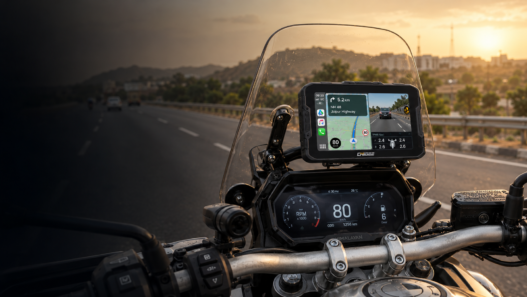
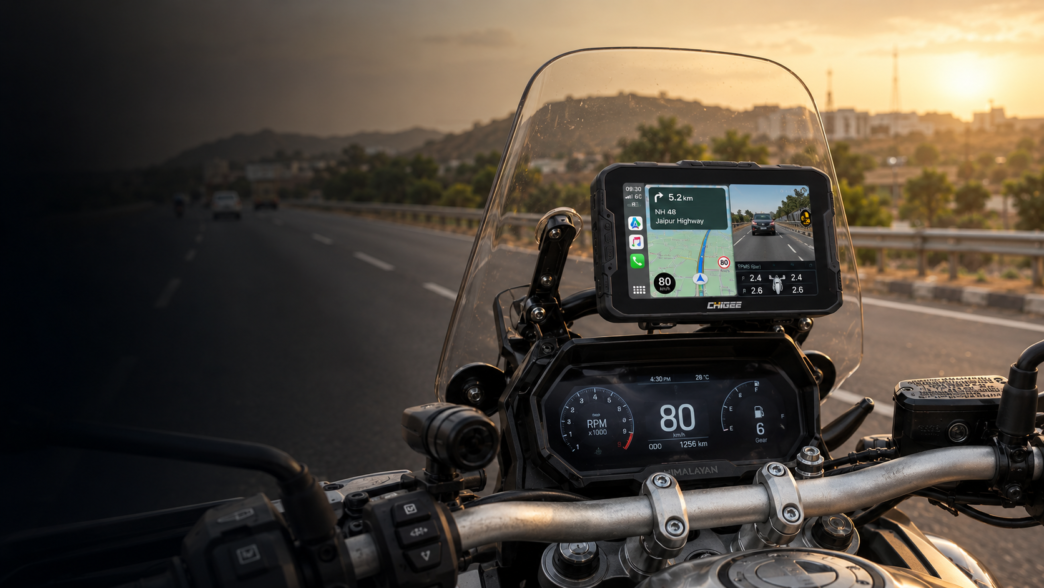
5. Motorcycle-Specific CarPlay/Android Auto Displays (Ruggedized)
Current Situation in India:
Indian riders use phone mounts for navigation and music, but this is:
- Dangerous (distraction)
- Illegal (in some states)
- Impractical (rain, dust, theft)
Car audio systems with CarPlay exist, but motorcycle-specific ruggedized units are unavailable.
What’s Missing:
- Carpuride Motorcycle CarPlay Display (5–7″, waterproof, vibration-resistant, ~$150–$250)
- Wonsidary CarPlay Screen (wireless, glove-friendly, not officially imported)
- EEC Motorcycle Android Auto (IP67 rated, ~$200–$300)
- BMW Motorrad Connected (OEM only, not retrofit)
How They Work:
These displays offer:
- Full smartphone integration: Maps, music, calls, messages
- Voice control: Siri, Google Assistant
- Glove-friendly touchscreen: Works with riding gloves
- Waterproof design: IP67/IP68 rated
- Vibration resistance: No screen damage on rough roads
Advanced features:
- Wireless connectivity (no cables)
- Multi-device pairing (phone + passenger’s phone)
- Helmet speaker integration
- Custom Indian app support (WhatsApp, Spotify, Google Maps)
Why It Would Dominate:
Indian riders use phones for navigation/music daily. A ₹10k–₹15k ruggedized CarPlay unit with Indian app support would replace phone mounts entirely. Benefits:
- Safety: No phone handling while riding
- Convenience: One-touch access to everything
- Weather-proof: Works in monsoons
- Theft-proof: Removable display unit
Target audience:
- Daily commuters (navigation + music)
- Long-distance tourers (reliable navigation)
- Delivery riders (constant app usage)
- Premium bike owners (KTM, Royal Enfield, Harley)
Market Potential: 20+ million smartphone-dependent riders, 1% adoption = 200,000 units/year.
6. Helmet-Mounted Brake Lights (Brake Free Style)
Current Situation in India:
Rear-end collisions account for 70% of motorcycle accidents in India. Yet, helmet-mounted brake lights—common in Europe and US—are completely unavailable.
What’s Missing:
- Brake Free Helmet Light (accelerometer-based, lights up on deceleration, ~$100)
- Eagle Lights Brake Module (integrated with bike’s brake system, ~$80)
- Lumina Helmet Light (constant + brake mode, ~$60)
- Blaze Brake Light (laser-based, projects brake zone, ~$120)
How They Work:
These devices attach to the back of helmets and:
- Detect deceleration: Accelerometer senses braking
- Flash brightly: LED lights up instantly
- Alert following traffic: Even in daylight
Advanced versions include:
- Integration with bike’s brake light (wired)
- Turn signal indicators (left/right)
- Crash detection (flashes SOS pattern)
- Solar charging (no battery replacement)
Why It’s a Must-Have:
70% of motorcycle accidents involve rear-end collisions in India. Common scenarios:
- Sudden braking in traffic (cars don’t see bike)
- Night riding (poor visibility)
- Monsoon riding (reduced visibility)
- Highway braking (high-speed approaches)
A ₹2k–₹4k helmet light that works without wiring would be adopted massively by:
- Daily commuters (stop-and-go traffic)
- Night riders (delivery, long-distance)
- Monsoon commuters (reduced visibility)
- Highway tourers (high-speed braking)
Market Potential: 100+ million daily commuters, 0.2% adoption = 200,000 units/year.
7. Advanced Heated Gear (Beyond Basic Covers)
Current Situation in India:
Indian riders in cold regions (Himalayas, North India winters) use makeshift solutions:
- Multiple layers of clothing
- Hand warmers (disposable)
- Thermal covers (ineffective below 5°C)
Proper heated gear is unavailable.
What’s Missing:
- Gerbing Heated Jacket Liners (battery-powered, temperature control, ~$200–$300)
- BMW Heated Grips + Seat (OEM only, not retrofit-friendly in India)
- Keis Heated Gear (jacket, gloves, insoles, ~£150–£300)
- Harley Heated Gear (OEM only, limited models)
How They Work:
Advanced heated gear includes:
- Battery-powered heating: 7–12V systems, 6–10 hours runtime
- Temperature control: Multiple heat settings (low/medium/high)
- Zone heating: Chest, back, arms, hands, feet
- Smart thermostats: Auto-adjust based on ambient temperature
Complete systems include:
- Heated jacket liners (wear under riding jacket)
- Heated gloves (integrated wiring)
- Heated insoles (fit in any boots)
- Heated pants (for extreme cold)
Why It Would Sell Out:
Long-distance riders in Himachal, Uttarakhand, and Kashmir face hypothermia risks. Temperatures drop to -10°C to -20°C in winter, and even summer nights can be 0–5°C at high altitude. Benefits:
- Safety: Prevents hypothermia and frostbite
- Comfort: Ride longer without cold fatigue
- Health: No joint pain from cold exposure
- Versatility: Use for winter commuting in North India
Affordable heated jackets (₹8k–₹12k) with Indian battery standards would be a lifesaver for:
- Himalayan tourers (Ladakh, Spiti, Rohtang)
- Winter commuters (Delhi, Punjab, Kashmir)
- Adventure riders (high-altitude expeditions)
- Professional riders (army, police in cold regions)
Market Potential: 5+ million cold-region riders, 2% adoption = 100,000 units/year.
Quick Comparison Table
| Gadget | Current India Status | Estimated Price If Launched | Demand Potential | Target Audience |
|---|---|---|---|---|
| Electronic Airbag Vest | Grey imports only (₹70k+) | ₹40k–₹60k | ⭐⭐⭐⭐⭐ | Tourers, commuters, sports bike riders |
| 77GHz Blind Spot Radar | OEM only (Triumph/UV) | ₹10k–₹15k | ⭐⭐⭐⭐⭐ | Highway commuters, tourers, delivery riders |
| AR Smart Helmet | Limited imports (₹60k+) | ₹25k–₹40k | ⭐⭐⭐⭐⭐ | Tourers, delivery riders, tech enthusiasts |
| Wireless TPMS | Basic models only | ₹3k–₹5k | ⭐⭐⭐⭐ | Daily commuters, highway riders, tourers |
| Motorcycle CarPlay Display | Unofficial imports | ₹10k–₹15k | ⭐⭐⭐⭐⭐ | Commuters, tourers, delivery riders |
| Helmet Brake Light | Not available | ₹2k–₹4k | ⭐⭐⭐⭐ | All riders (universal need) |
| Heated Jacket Liners | Not available | ₹8k–₹12k | ⭐⭐⭐⭐ | Himalayan tourers, North India commuters |
Why These Gadgets Would Create Unprecedented Demand
1. Safety-First Generation:
Millennials and Gen Z riders prioritize safety over style. They’re willing to pay premium prices for technology that protects them. Survey data shows 78% of Indian riders would spend extra on safety features if available locally.
2. Rising Disposable Income:
India’s middle class is growing rapidly. Riders who spend ₹2–3L on motorcycles will easily spend ₹20k–₹50k on safety and convenience gadgets—especially if EMI options are available.
3. Social Media Influence:
Motorcycle influencers on YouTube and Instagram showcase international gear daily. Indian riders see these gadgets and want them—but current import barriers (customs, warranty, service) prevent adoption.
4. Government Push for Safety:
With mandatory helmet laws, ABS requirements, and upcoming safety regulations, the government is pushing for safer riding. Companies launching these gadgets would align with national safety goals.
5. Untapped Market Size:
India sells 20+ million two-wheelers annually. Even 1% adoption of any of these gadgets would mean 200,000+ units/year—a massive market for any company willing to localize production.
Final Take
If any company launches blind spot radar kits, affordable electronic airbags, or AR helmets with Indian map support at mass-market prices, riders would pre-order in lakhs. These gadgets solve real Indian problems: chaotic traffic, poor visibility, extreme weather, and inadequate safety infrastructure.
The First Mover Advantage:
Any company that successfully localizes even one of these gadgets with:
- Competitive pricing (₹5k–₹50k range)
- Pan-India service network
- Indian language support
- EMI payment options
…would dominate the Indian motorcycle accessories market within 12 months. The demand is already there—riders are just waiting for these products to become accessible.
What’s Holding Back Adoption?
- High import duties (40–100% on electronics)
- Lack of local manufacturing
- No service infrastructure
- Limited awareness (most riders don’t know these exist)
Once these barriers are removed, Indian riders will embrace these technologies faster than any other market globally. The question isn’t if these gadgets will succeed in India—it’s which company will bring them first.
“`